Bag hardware works as part of an assembly with webbing, fabric and stitching. A snap hook may fit through a D-ring yet bind when it turns. An adjuster may match the nominal strap width but fail to hold that particular webbing as intended. Start with the assembly design, then choose the components.
This guide helps designers, workshops and purchasing teams prepare a bag hardware list, check the relevant dimensions and assess a sample before ordering a production batch. It concerns ordinary bags and backpacks, not the selection of fall-protection equipment.
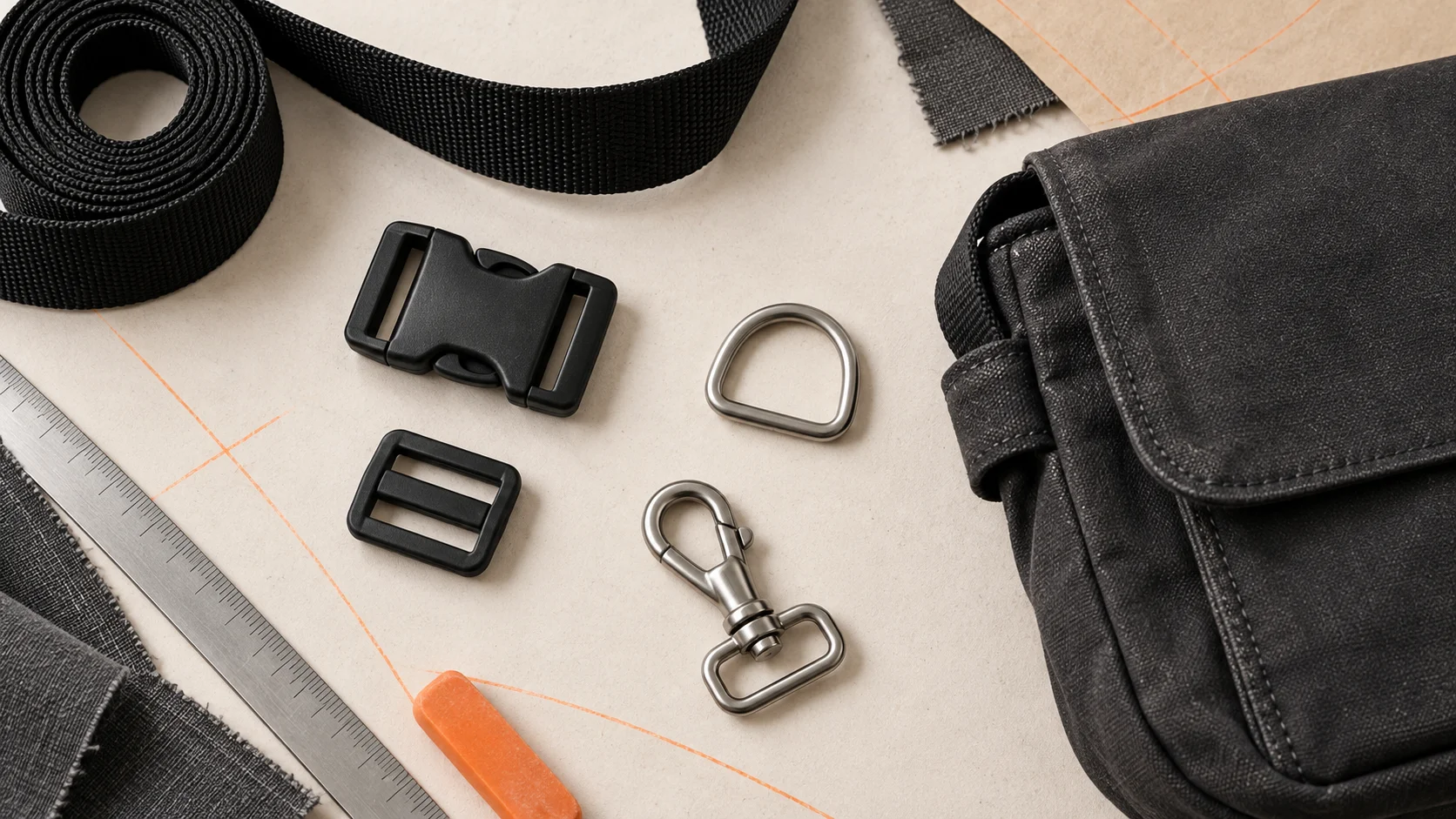
AI-generated editorial illustration. It does not depict specific DELIM items or a compatibility-tested set.
Which bag hardware does your design need?
Draw the strap path first: where it is sewn in, where it detaches, how its length changes and what it connects to. This separates necessary components from items that simply look appealing in a catalogue.
| Function | Parts | Check together |
|---|---|---|
| Detach a shoulder strap | Snap hook and a suitable ring or D-ring | Strap opening, hook opening, ring thickness and freedom of movement |
| Adjust strap length | Strap adjuster | Webbing width and thickness, layer count and threading route |
| Release a strap or flap quickly | Side-release buckle | Exact models of both halves, orientation and attachment to the webbing |
| Attach a handle or loop | Frame, ring or D-ring | Internal dimensions, material fold and stitching location |
| Close a compartment or pocket | Zipper and matching slider | Series, size, construction and installation method |
Not every bag needs all these components. A fixed, sewn-in handle may need neither a snap hook nor an adjuster. A detachable shoulder strap, on the other hand, requires both attachment points to be described. The bag snap hook, buckle and adjuster and frame and D-ring categories help turn a functional requirement into a shortlist.
Strap width is only the start of a fit check
“For 25 mm webbing” narrows the search; it does not establish compatibility. Measure the webbing itself and record its thickness. Check how many layers must pass through each slot: a single layer and a folded, stitched end take up different amounts of space.
On the component drawing, identify the relevant opening and clearance rather than using the overall body width. With a snap hook, also check whether the ring passes through the hook opening and whether the assembled connection can be fastened comfortably. For a swivel design, inspect its movement after assembly: the fabric and attachment loop must not obstruct it.
When selecting fabrics and hardware together, assess the attachment on the complete material stack. Outer fabric, lining, reinforcement and stitching all affect the assembly. A suitable opening in a frame says little about whether the sewn attachment itself is suitable.
Metal or plastic bag hardware?
“Metal is stronger; plastic is lighter” is not a sufficient selection rule. You need information about the exact model, material, geometry, operating conditions and installation. A photograph or a broad material category cannot establish an allowable load.
Metal bag hardware may be part of the product's intended appearance. If so, specify the required finish and colour, expected moisture exposure and any documentation requirements. Do not assume that an unidentified alloy has corrosion resistance or other properties without evidence.
For plastic hardware, confirm the material of the exact variant too. It can differ between sizes within a single series. Compare parts against your bag's requirements rather than assumptions about an entire category. Also inspect whether component edges or the threading route damage the webbing while the assembly is operated.
Example: a detachable shoulder strap assembly
Consider a hypothetical bag with an adjustable shoulder strap made from 25 mm webbing. This is an example of preparing a specification, not a recommended off-the-shelf set.
The design might use two snap hooks, two corresponding attachment points on the bag and one length adjuster. Next, determine whether the webbing passes through the openings, how it threads through the adjuster and how the free ends are finished. Check the fabric, reinforcement and stitching separately for the sewn attachment loops.
Give every component its own specification row: model, size, material variant, colour and quantity per finished bag. Calculate the batch quantity from that bill of materials. Agree sample quantities, production reserves and spare components separately. Do not automatically apply a fabric allowance percentage to the hardware count.
Reading specific catalogue entries
Three examples illustrate why a component name is not enough to select a variant:
- The Due Emme (2M) MCS snap hook is listed in the bag snap hook category. Its card includes a 25 mm variant, a drawing and separate material descriptions from the cited sources. Confirm the required variant rather than ordering by the MCS code alone.
- The Due Emme (2M) LS three-slot adjuster is listed in 20, 25 and 50 mm sizes. Its card specifies PA6 for 20 and 25 mm and POM for 50 mm. Do not extend the material specification of one size to the whole series.
- The Due Emme (2M) NBS rounded side-release buckle on this card is 40 mm. It demonstrates a different fastening function; it is not an automatic substitute for components in the hypothetical 25 mm strap.
These models are not a compatibility-tested, interchangeable set. Confirm the current variant, availability, documentation and sample options for your request. The 2M brand page provides links to further component groups.
What to check on a sample before production
Build the assembly using the actual webbing and material stack intended for production. Testing a loose snap hook on a workbench does not show how the sewn attachment will behave.
- Match the item code, variant and supplied parts against the agreed specification.
- Thread the strap as designed. Check adjustment, length retention and the treatment of the free end.
- Fasten and release the assembled bag. Check access to the components and whether the lining interferes.
- Perform load and repeated-operation checks against your product requirements, recording the conditions and acceptance criteria. This article does not set a universal test specification.
- Record which sample was approved. A change to the webbing, component material or stitching may require another check.
For a zipper, use the separate YKK slider selection guide. Matching size numbers do not establish compatibility across every series.
Errors to resolve before purchasing
An incomplete description is often more problematic than the length of the hardware list. Do not select a part solely from its overall dimensions in a photograph, assume that equal-width buckle halves fit together or substitute a material without checking the assembly. When agreeing a colour, identify the exact model: a manufacturer's general palette does not establish availability for every variant.
For wholesale sewing hardware purchases, agree the component list and sample first, then the quantities and commercial terms. Send the same specification to each supplier when comparing proposals.
Frequently asked questions
Is strap width enough to select a component?
No. Include webbing thickness, the threading route, the number of layers through the slot and the dimensions of adjacent components. Check compatibility in the assembled connection.
Can I replace only one half of a side-release buckle?
Only after checking the specific halves for compatibility. The same nominal width or a similar appearance does not establish a match. If the variant is unknown, provide photographs of the markings and both parts.
Does DELIM accept small orders?
DELIM primarily works with manufacturers and also accepts retail enquiries. A manager confirms the price, feasibility of supplying the requested quantity, packaging and lead time for the selected item.
Turn the assembly into a specific enquiry
Bag hardware needs to suit the complete assembly. Prepare a sketch or photographs, strap width and thickness, a component list, the number of finished products and your sample-check requirements. State what has already been approved and what still needs selecting.
Send your requirement to a DELIM manager or use the sewing hardware enquiry checklist. These details allow a discussion of exact items, samples and supply terms without assuming universal compatibility.